
Skills and education
Skills
My core strength is statistical modelling under uncertainty. The same discipline now runs my AI engineering: retrieval pipelines, agents and the evaluation that proves they work. Research added the habits that transfer: measurement design first, explicit assumptions, delivery under real constraints and writing that can be audited.
What I deliver
- End-to-end AI systems. Retrieval-augmented generation (RAG) pipelines with measured retrieval, agent workflows with tool calling, and fine-tuned models.
- Full-cycle modelling. Problem framing, model selection, validation and uncertainty-aware decision support.
- Data pipelines. Clean, testable, version-controlled paths from raw data to decision-ready outputs with Python and SQL.
- Evaluation and communication. Leakage checks, calibration, error slicing and stress testing, reported with explicit assumptions and limits.
Depth, by area
-
AI engineering
I build language model systems and prove they work: grounded generation, agentic systems, fine-tuning and evaluation.
- Retrieval over vector stores (ChromaDB) and knowledge graphs (Neo4j, Cypher), measured for groundedness and relevance
- Agent workflows in LangGraph: planning loops, tool calling and human checkpoints
- Judge models benchmarked against labelled data, traced with Arize Phoenix
- Fine-tuning: supervised frontier runs and QLoRA on open Hugging Face models
- Guardrails: cross-family review models, per-turn logging and drift detection
- Model Context Protocol (MCP) servers and clients, built with FastMCP and deployed remotely
-
Statistical modelling under uncertainty
Bayesian hierarchical methods for noisy, sparse and structured data, with uncertainty carried into every forecast.
- Generalised linear, additive and mixed models with partial pooling
- Observation separated from process: N-mixture and integrated population models
- Spatiotemporal forecasting, species distribution models and threshold inference
- Gradient boosting with XGBoost, clustering and SHAP interpretability
- Validation design: temporal splits, leakage checks, calibration and causal framing
The methods grew from field ecology research, recorded on the Research page.
-
Data and software foundations
Reliable engineering around the models: pipelines, reproducibility, geospatial work and delivery apps.
- Ingestion and transformation with pandas and scikit-learn: schema discipline, typed and tested code
- Analytical queries on PostgreSQL: joins, window functions, common table expressions and reusable views
- Reproducibility: pinned environments, deterministic runs, versioned artefacts and Git throughout
- Raster and vector workflows in R, with spatial feature engineering
- Delivery apps in Gradio, Streamlit and Shiny
- Cloud foundations on Amazon Web Services, certified at practitioner level: core services, identity and access, monitoring and cost governance
Languages: Spanish (first language), English (IELTS 7.0), French (basic).
Education
-
Ph.D. in Quantitative Ecology
James Cook University
The doctorate built modelling frameworks that predict vulnerability to extreme events and locate high-risk habitat.
-
M.S. in Biology and Conservation of Biodiversity
Universidad de Salamanca
The master's degree centred on spatial analysis and statistical modelling for conservation planning.
-
B.S. in Biology
Universidad de Salamanca
The bachelor's degree grounded biology in mathematics, biostatistics and ecological modelling.
Certificates and training
-
AI engineering
- AI Engineer Core Track: LLM Engineering, RAG, QLoRA, Agents (certificate). Covers frontier APIs, open-source models, RAG, frontier and QLoRA fine-tuning, and agent deployment with LangChain and Gradio.
- ChatGPT Prompt Engineering for Developers (certificate). Covers structured prompting, iterative refinement and the OpenAI API.
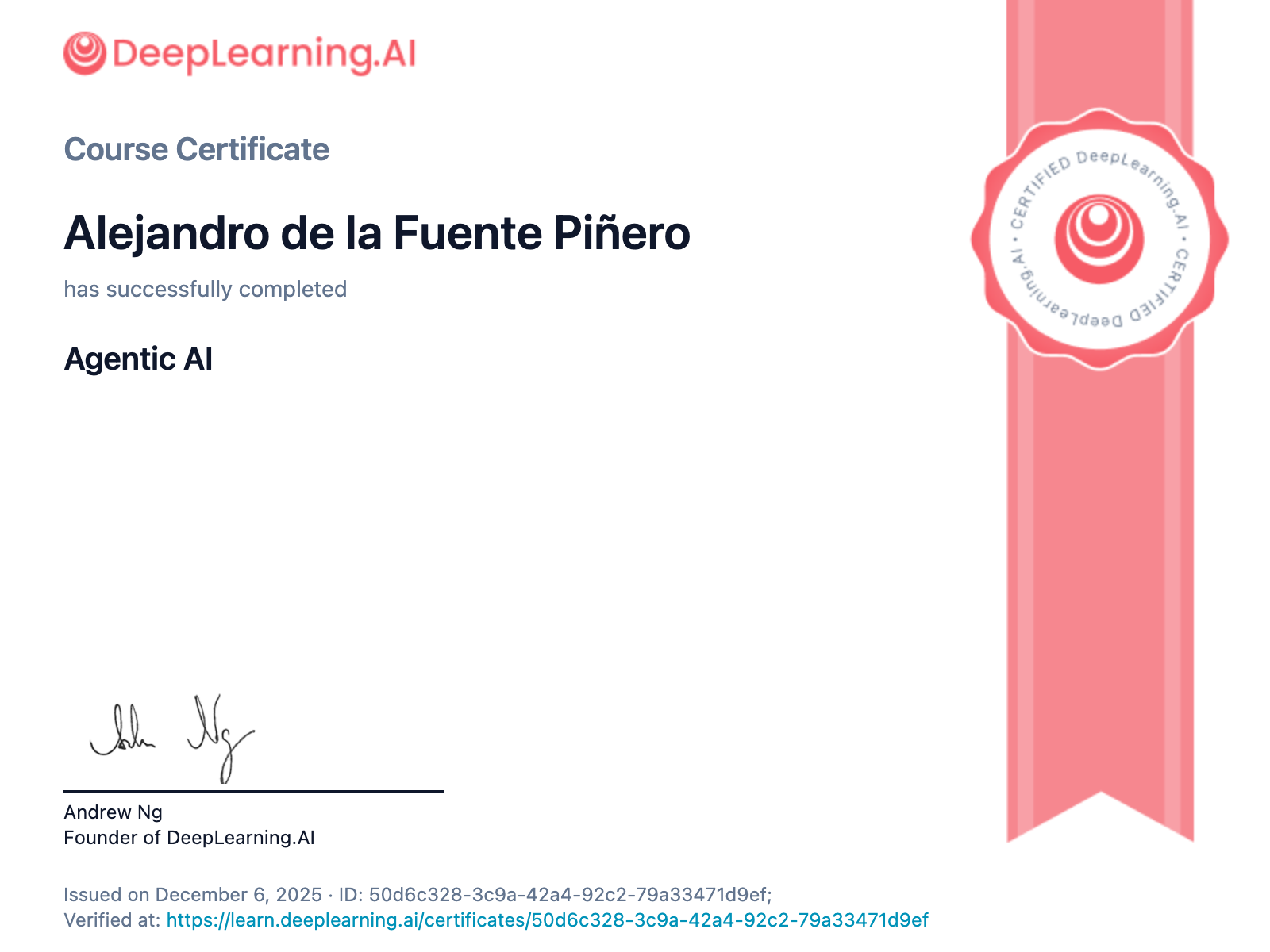
- Agentic AI, Andrew Ng (certificate). Covers task decomposition, reflection, tool calling and multi-agent coordination.
- AI Agents in LangGraph (certificate). Covers graph-structured agent workflows, state, tracing and human-in-the-loop checkpoints.
- Evaluating AI Agents, DeepLearning.AI (Arize AI) (certificate). Covers agent decomposition, tracing with Arize Phoenix, router, skill and trajectory evaluations, judge design and production monitoring.
- Building and Evaluating Advanced RAG, DeepLearning.AI (LlamaIndex, TruEra) (certificate). Covers the RAG triad with TruLens, sentence-window and auto-merging retrieval, and evaluation-driven iteration.
- Knowledge Graphs for RAG, DeepLearning.AI (Neo4j) (certificate). Covers Cypher, vector search over graph data and graph-backed question answering.
- Agentic Knowledge Graph Construction, DeepLearning.AI (Neo4j) (certificate). Covers multi-agent schema inference and knowledge graph construction with Google’s Agent Development Kit.
- Claude Code: A Highly Agentic Coding Assistant, Anthropic (certificate). Covers agentic coding workflows, context discipline, subagents, git worktrees, hooks and MCP servers.
- Agent Skills with Anthropic (certificate). Covers skill design and packaging, progressive disclosure, and skills with the Claude API and the Claude Agent SDK.
- MCP: Build Rich-Context AI Apps with Anthropic (certificate). Covers MCP servers and clients with FastMCP, reference servers and remote deployment.
-
Python and machine learning
- The Complete Python Bootcamp: From Zero to Hero in Python (certificate). Covers core Python, data structures, OOP, error handling, file work and web scraping with Requests and BeautifulSoup.
- Python for Data Science and Machine Learning Bootcamp (certificate). Covers pandas, NumPy, Matplotlib, Seaborn, Plotly and scikit-learn: regression, trees, random forests, SVM, k-NN, K-Means, PCA, intro NLP and deep learning with Keras and TensorFlow.
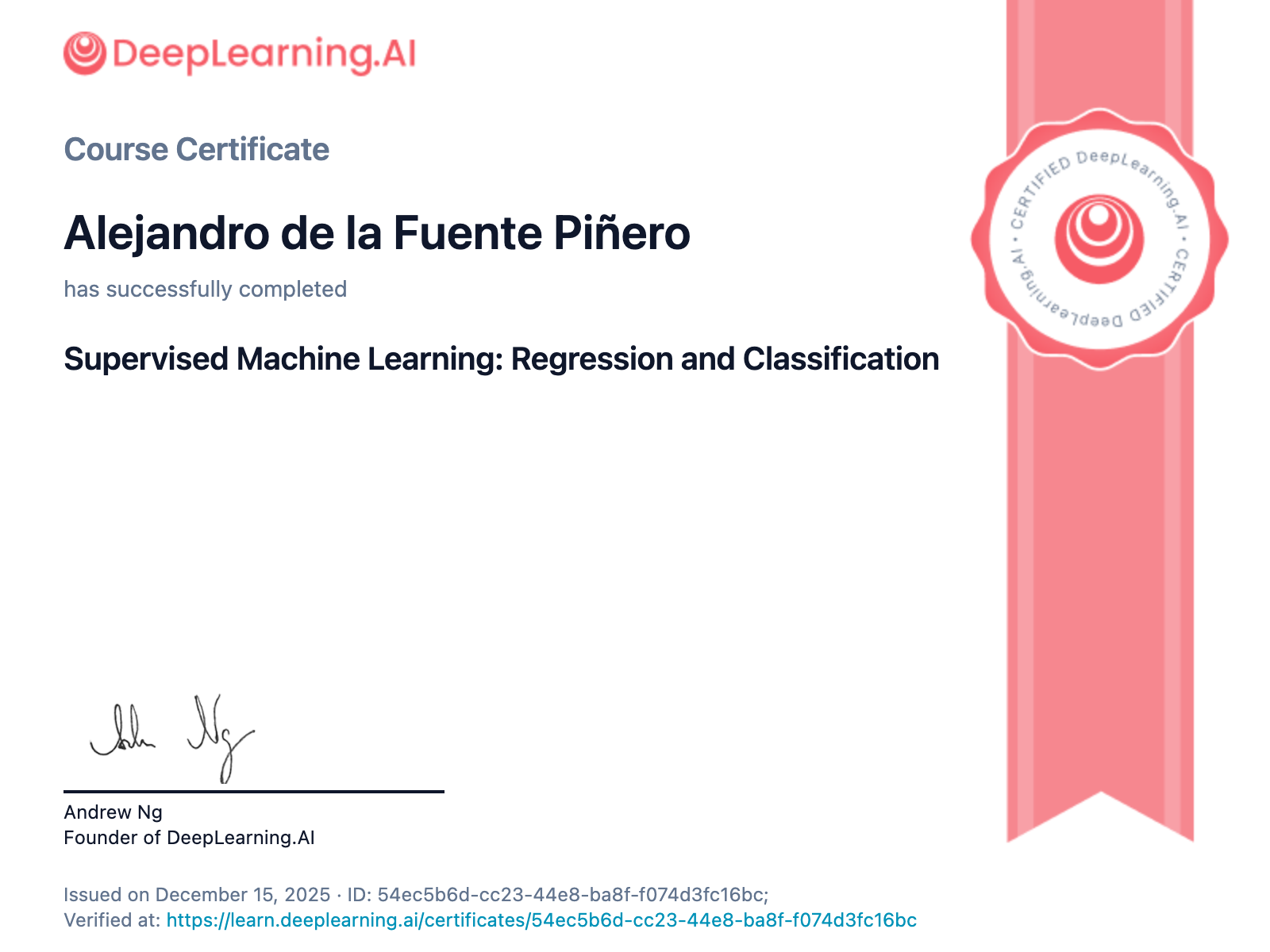
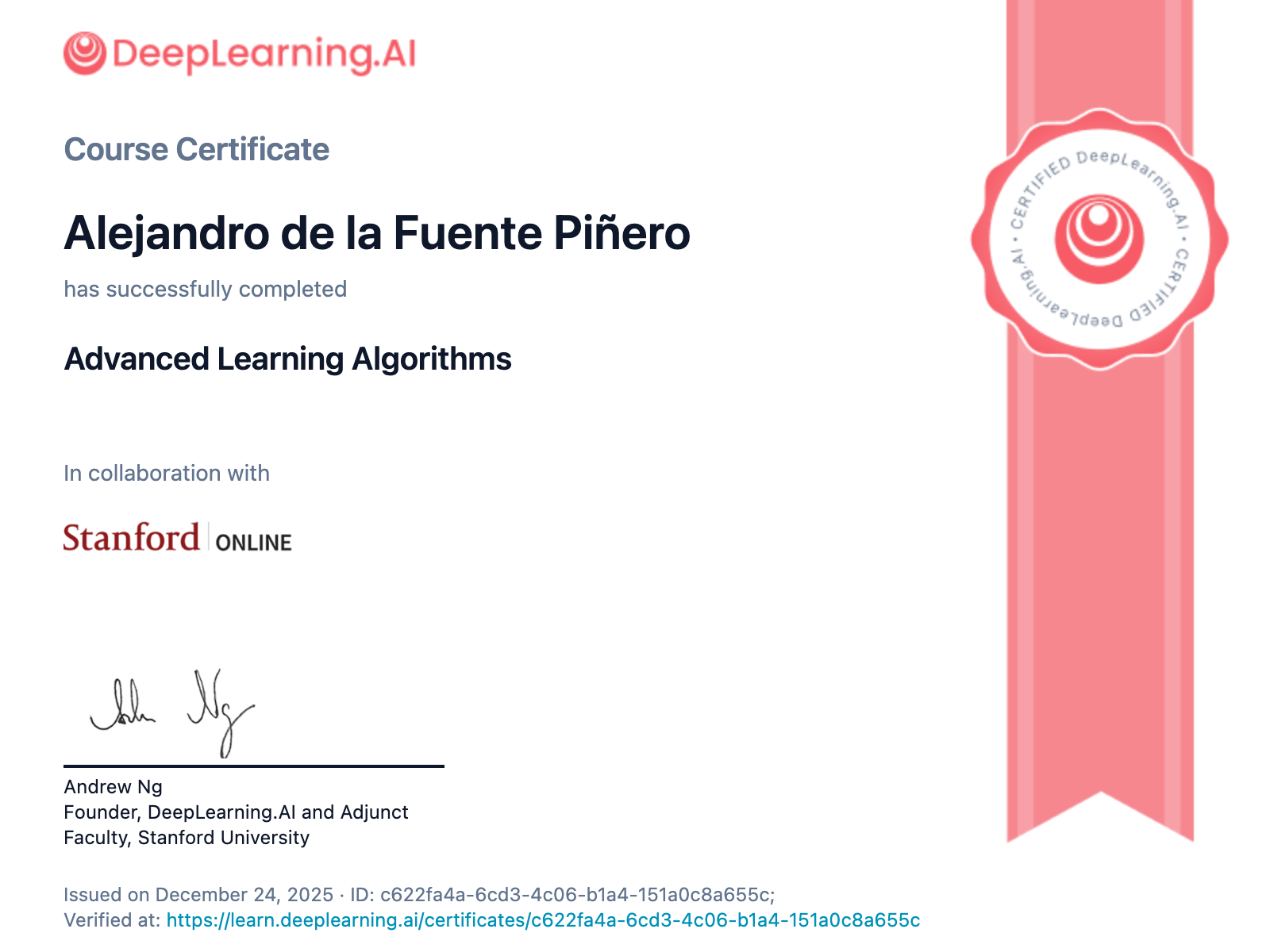
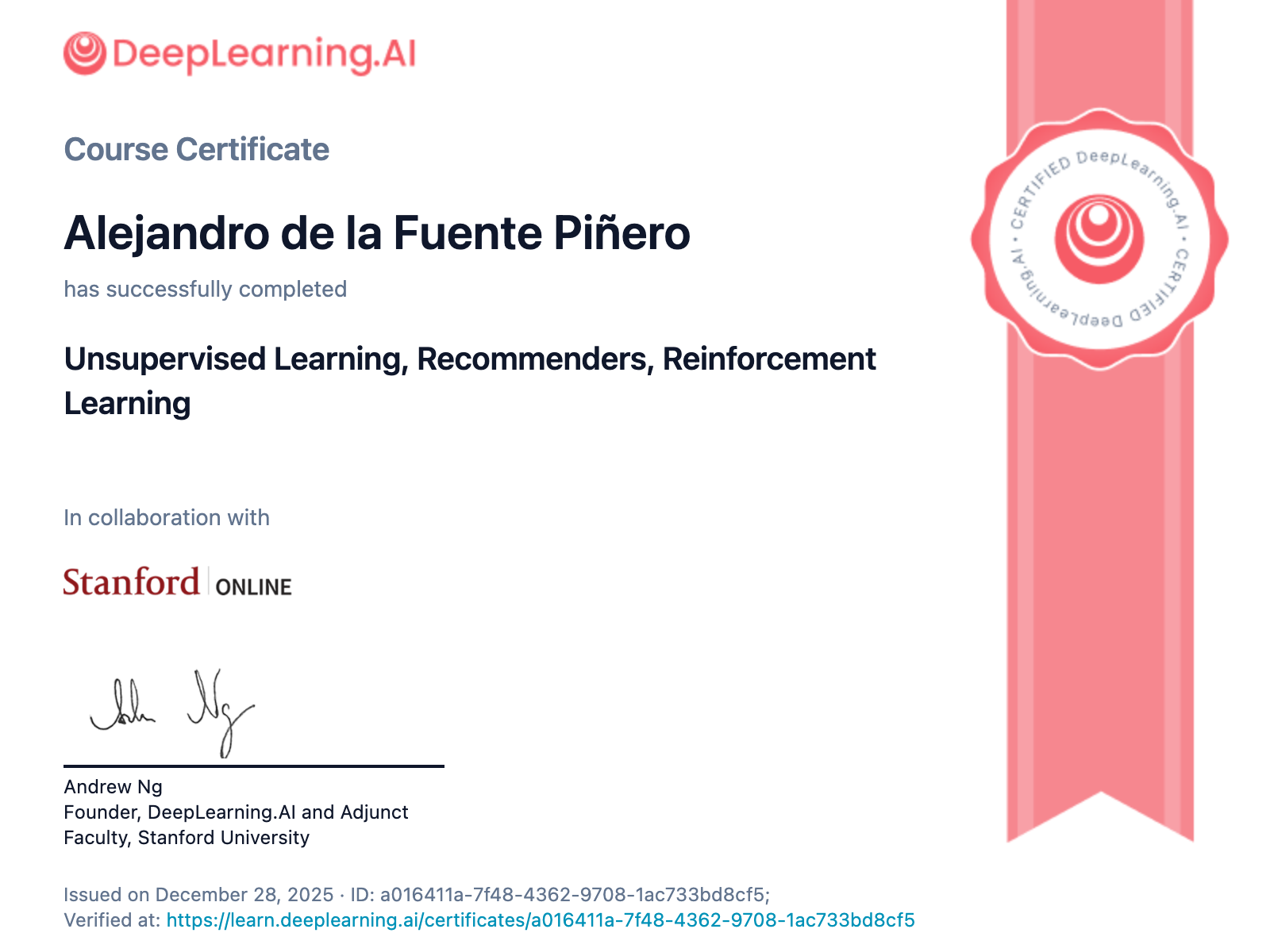
- Machine Learning Specialisation, DeepLearning.AI, Andrew Ng (certificate). Covers supervised learning, advanced learning algorithms, unsupervised learning, anomaly detection, recommenders and introductory reinforcement learning. Module certificates: supervised learning, advanced algorithms, unsupervised learning.
-
Bayesian and hierarchical modelling
- Statistical Rethinking: A Bayesian Course with Examples in R and Stan
- Statistical Rethinking 2023, online course, Richard McElreath
- Bayesian Methods for Ecology, Michael A. McCarthy
- Applied Hierarchical Modeling in Ecology
- Integrated Population Models
-
R
- R for Data Science
- Statistics in R workshop, Dr Murray Logan (AIMS). Covers tidyverse, ggplot2, R Markdown, linear models, GLMs and GLMMs, mixed-effects models and multivariate analyses.
-
SQL and databases
- The Complete SQL Bootcamp: PostgreSQL & pgAdmin (certificate). Covers querying, aggregation, joins, schema fundamentals and pgAdmin tooling.
- SQL for Data Analysis: Advanced SQL Querying Techniques (certificate). Covers subqueries, CTEs, window functions, NULL-safe handling and reusable views.
-
Version control
- The Git & GitHub Bootcamp (certificate). Covers branching, merging, rebasing, recovery workflows and GitHub collaboration.
-
Cloud
- AWS Certified Cloud Practitioner, CLF-C02 (certificate). Covers core AWS services, IAM, networking, monitoring and cost governance at a conceptual level.