
Job Intelligence Engine
Published:
Links (start here)
- Live app: Streamlit App
- GitHub repo: Job Intelligence Engine
Overview
Job postings are noisy: roles and skills overlap heavily in meaning, postings describe the same requirements with different language, and “fit” often devolves into keyword matching or generic advice. The result is wasted time—applying to roles that are either unrealistic right now or undershoot your actual potential.
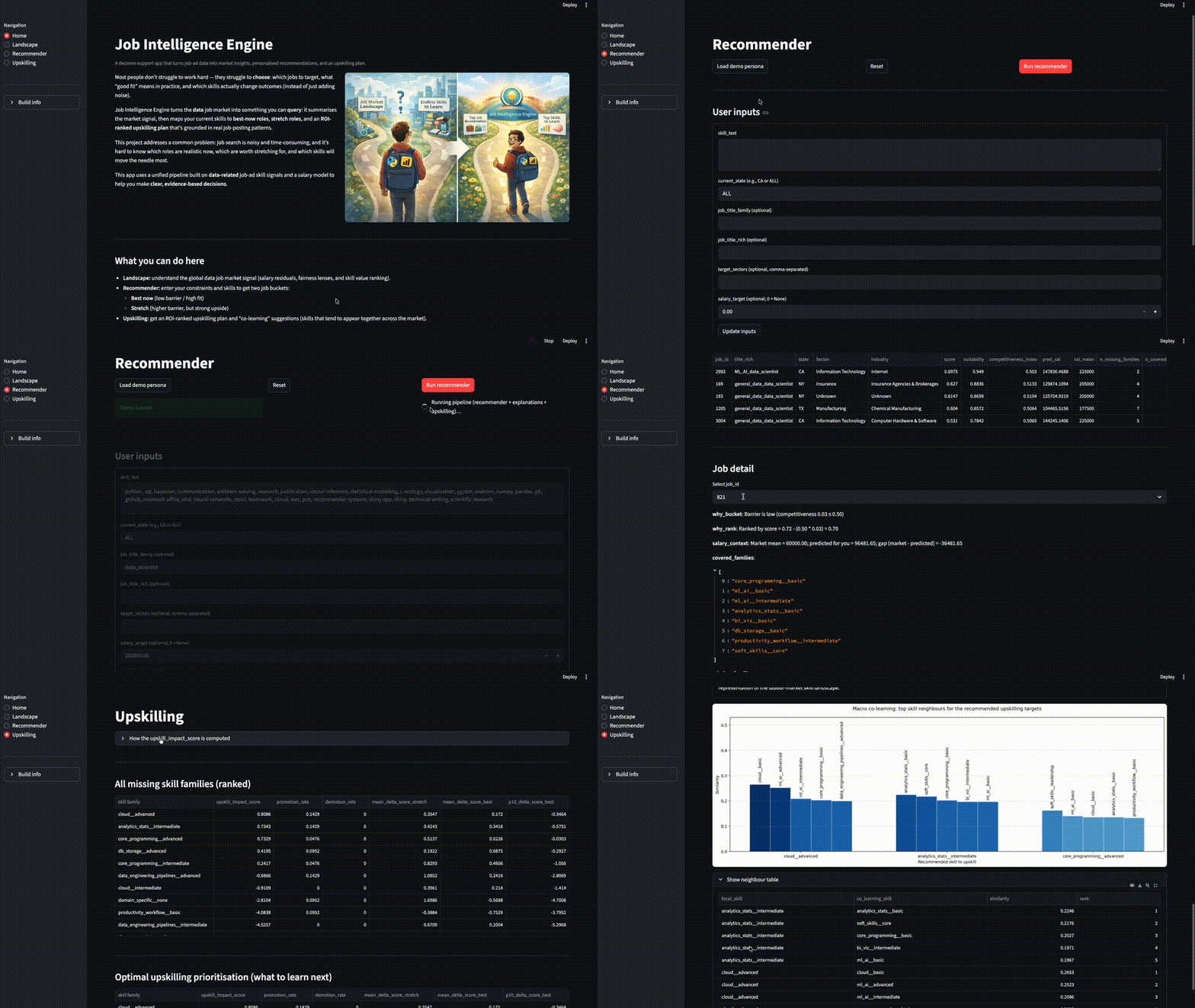
Job Intelligence Engine converts raw job ads into a structured, interpretable market layer, then positions an individual within that landscape to make decisions that are both realistic and strategic. The app surfaces recommendations with explicit rationale and interpretation panels; the repo contains the deterministic pipeline and persisted artefacts that reproduce those outputs.
- What roles are realistic now (high fit, low friction)?
- What roles are worth a stretch (clear upside, clear gaps)?
- What should I learn next to change my options measurably?
What it delivers
- Interpretable market signals: structured skill demand and salary drivers you can inspect and reason about.
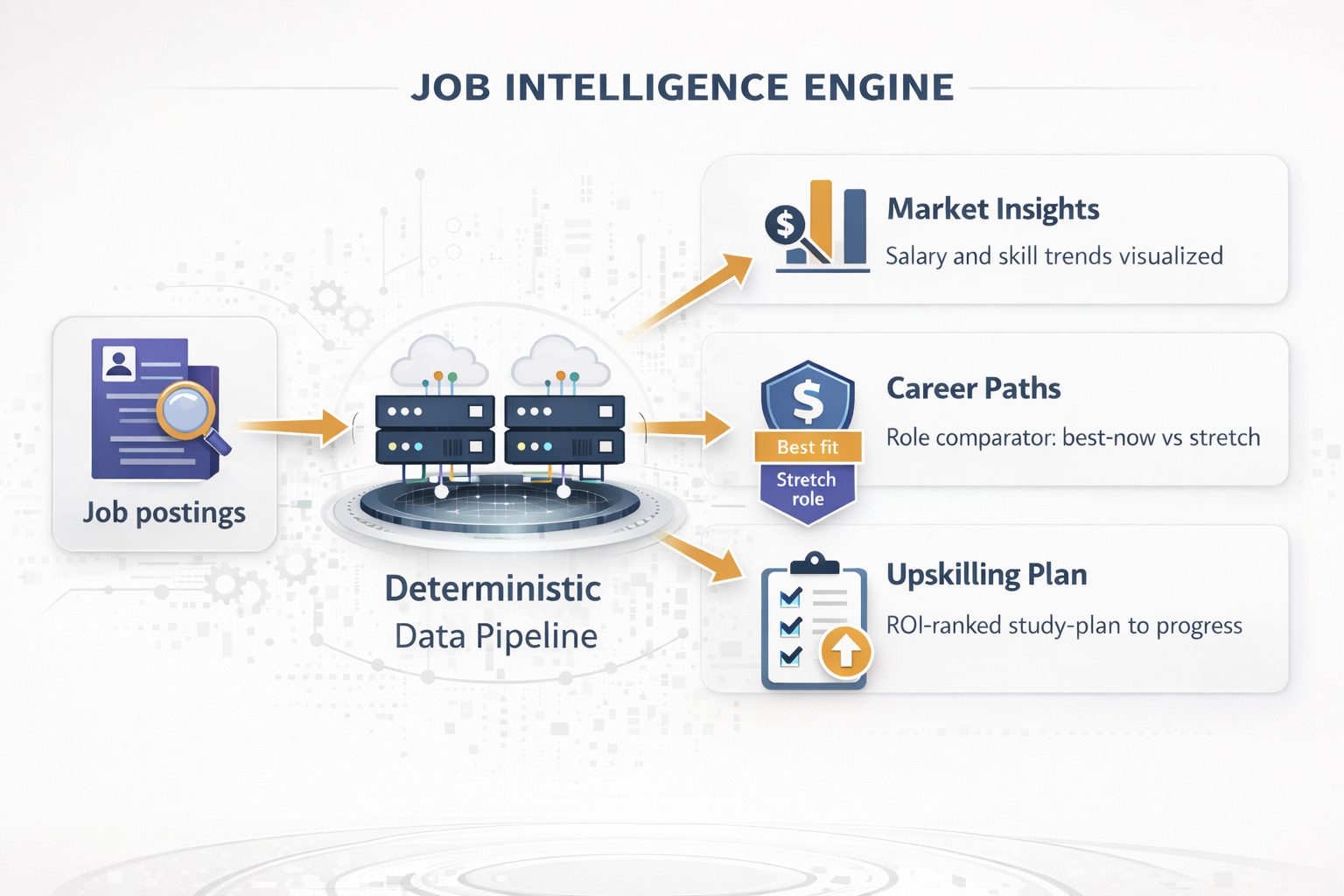
- Career positioning: separates best_now roles (strong fit, lower barriers) from stretch roles (higher upside, clearer gaps), with explicit rationale.
- Upskilling recommendations: counterfactual “add-one-skill” analysis that ranks what to learn by the change it produces in suitability, competitiveness, and salary alignment.
How it works
The system runs as a deterministic pipeline. It normalises raw postings (titles, locations, salaries, skill tokens), learns market structure via probabilistic skill-requirement models and a tuned salary model, then translates those signals into transparent positioning scores, recommendations, and upskilling targets. The engine separates suitability (fit to your current profile) from competitiveness (barrier to entry driven by missing or rare skill requirements) — a distinction most job tools collapse into a single score. Outputs are served through a lightweight Streamlit interface.
Stack
Python · pandas · NumPy · scikit-learn · SBERT · XGBoost/LightGBM · SHAP · Streamlit · NetworkX